
Table of Contents
A Current Transformer (CT) is an electrical instrument transformer that safely reduces high current values into standardized lower values suitable for measurement, monitoring, and protection devices.
CTs allow electricians and engineers to measure large electrical currents without directly connecting measuring instruments to high-voltage circuits.
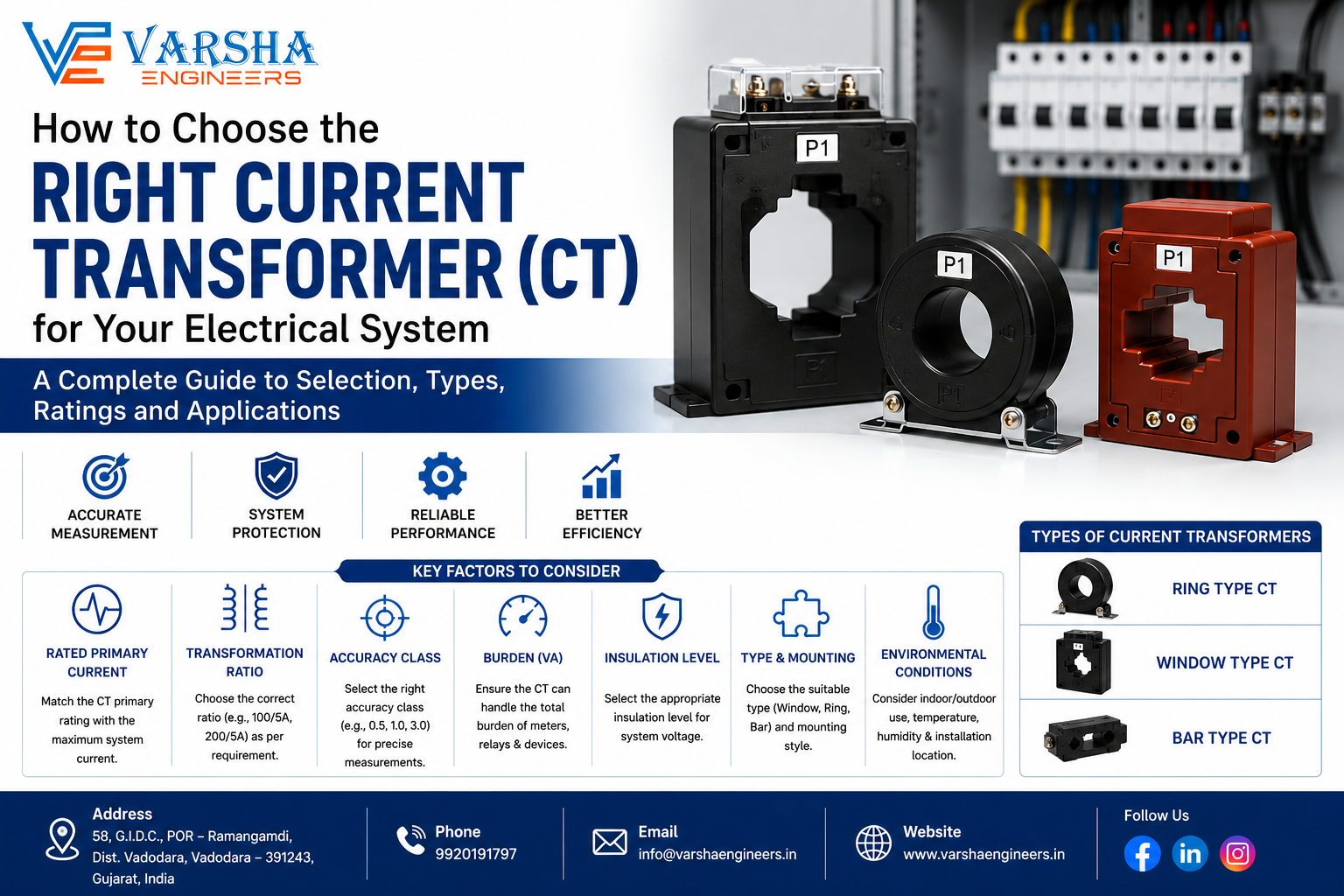
Choosing the right Varshaengineers Current Transformer (CT) is essential for ensuring accurate current measurement, reliable protection, and efficient power monitoring in any electrical system. Whether you're designing a new electrical installation or upgrading an existing one, selecting the correct CT helps improve system performance, protects valuable equipment, and ensures compliance with electrical standards.
Current Transformers are widely used in industrial plants, commercial buildings, substations, power distribution networks, and renewable energy systems. However, selecting the wrong CT ratio, accuracy class, or burden rating can lead to inaccurate readings, equipment malfunction, or even system failure.
In this comprehensive guide, you'll learn everything you need to know about choosing the right Current Transformer for your electrical application—from understanding CT basics to selecting the ideal ratio, accuracy class, installation method, and maintenance practices.
A Current Transformer converts high primary current into a proportional secondary current, typically 5A or 1A.
It provides:
CTs are commonly installed in:
Selecting the correct Current Transformer ensures:
Using an incorrect CT may result in:
Installed around conductors or busbars and commonly used in switchboards and control panels.
Uses the conductor itself as the primary winding and is suitable for high-current applications.
Contains primary windings inside the transformer and provides higher measurement accuracy.
Can be installed without disconnecting the conductor, making it ideal for retrofit projects.
Compact and commonly used for metering applications.
Choose a CT that matches the maximum expected load current.
The standard secondary current is usually:
Select according to the application:
Ensure the CT can support connected meters, relays, and wiring without losing accuracy.
Consider:
Select a CT that fits comfortably within the available panel or switchgear.
The CT ratio represents the relationship between primary and secondary current.
Examples:
Choose a ratio slightly higher than the normal operating current to maintain measurement accuracy while allowing for future load growth.
Different applications require different accuracy levels.
Common accuracy classes include:
Metering applications require high accuracy, while protection systems prioritize reliable relay performance during fault conditions.
Burden refers to the total load connected to the CT secondary.
It includes:
Selecting the proper burden rating prevents measurement errors and overheating.
For safe and reliable installation:
Avoid these common errors:
Regular maintenance helps maximize CT performance.
Recommended practices include:
Routine maintenance improves reliability and extends equipment life.
| Parameter | Recommendation |
|---|---|
| Primary Current | Match the maximum expected load |
| Secondary Current | 1A or 5A |
| Accuracy Class | Based on metering or protection |
| Burden Rating | Match connected load |
| CT Type | Window, Bar, Wound, Split Core, Ring |
| Installation | Indoor or Outdoor |
| Mounting | Panel or Busbar |
| Future Expansion | Select a slightly higher current rating |
A Current Transformer safely measures high electrical currents by converting them into lower standardized values for meters and protection devices.
Select a CT ratio that closely matches your maximum operating current while allowing room for future expansion.
Metering CTs provide highly accurate current measurements, whereas Protection CTs are designed to operate reliably during fault conditions.
An open CT secondary can generate dangerously high voltages, potentially damaging equipment and posing serious safety risks.
Industrial facilities generally inspect CTs annually or according to preventive maintenance schedules.
In some systems, yes, but separate CTs are generally recommended to achieve the best accuracy and protection performance.
Selecting the right Current Transformer (CT) is a critical step in designing a safe, efficient, and reliable electrical system. By carefully considering factors such as CT ratio, accuracy class, burden rating, installation environment, and future load requirements, you can ensure accurate current measurement, dependable equipment protection, and long-term system reliability.
Whether you're working on an industrial facility, commercial building, renewable energy project, or power distribution network, investing time in proper CT selection helps reduce operational risks, improve efficiency, and extend the lifespan of your electrical infrastructure.