
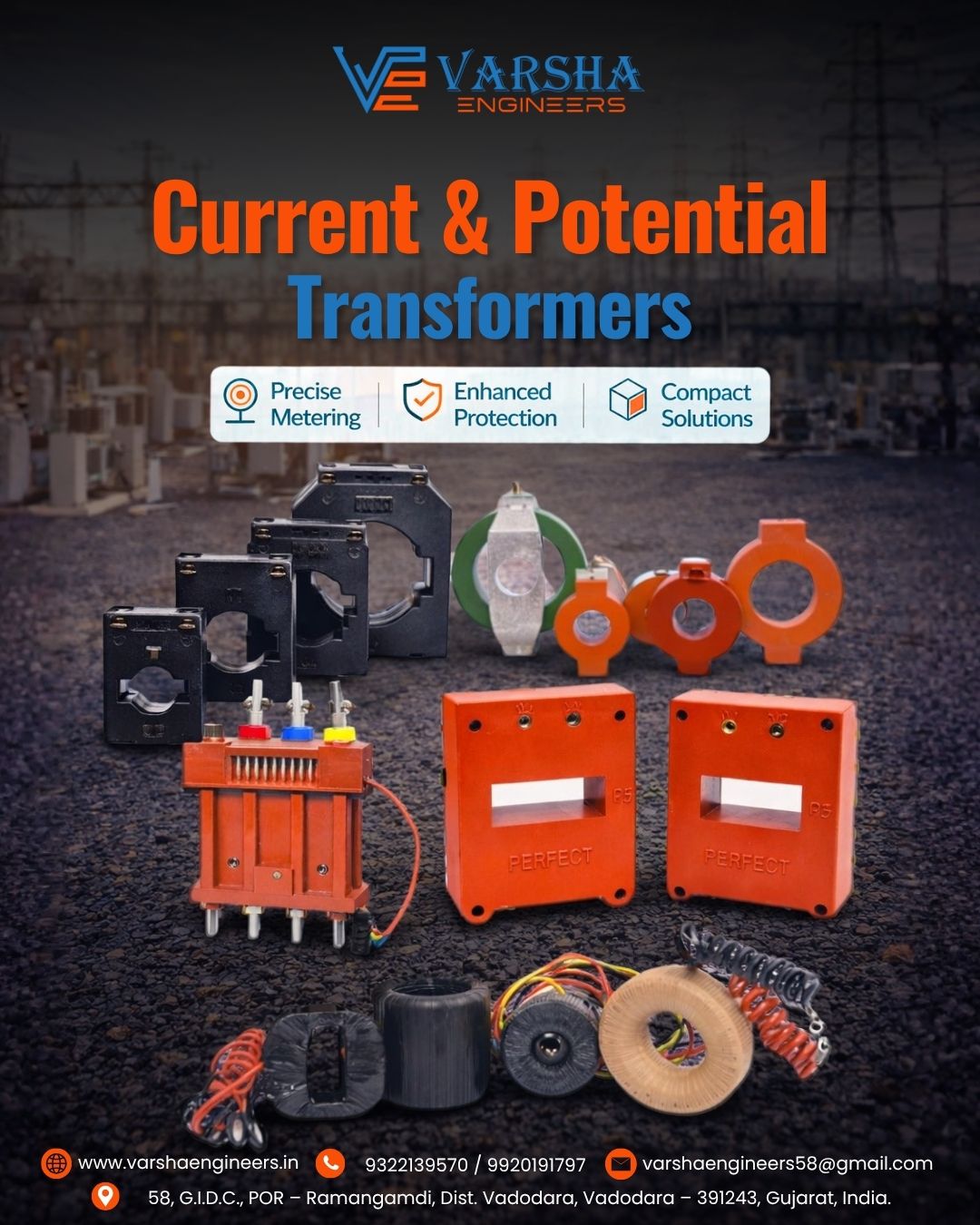
Current and Potential Transformers are essential components in modern electrical power systems. These instrument transformers help measure high current and high voltage safely while protecting measuring instruments and electrical equipment. Whether used in substations, industries, commercial buildings, or power distribution networks, Current Transformers (CTs) and Potential Transformers (PTs) ensure accurate metering, system monitoring, and electrical protection.
Varsha Engineers manufactures high-quality Current and Potential Transformers designed with precision engineering, excellent insulation, and reliable performance. Their transformers meet industrial standards and provide long-term durability for various electrical applications.
In this comprehensive guide, you'll learn about the working principle, types, applications, benefits, technical specifications, and selection tips for Current and Potential Transformers.
Electrical power systems often carry extremely high currents and voltages that cannot be directly measured using standard instruments. Current Transformers (CTs) and Potential Transformers (PTs) solve this problem by reducing electrical values to safe levels for accurate measurement and protection.
These transformers play an important role in substations, industrial plants, commercial buildings, renewable energy projects, and power distribution systems. They help improve operational safety, equipment protection, and energy monitoring while maintaining high measurement accuracy.
Current and Potential Transformers are instrument transformers designed to convert high electrical values into standardized low values suitable for measuring instruments and protective relays.
Current Transformers reduce current levels, whereas Potential Transformers reduce voltage levels without affecting measurement accuracy.
A Current Transformer (CT) is designed to convert high current into a smaller standardized current, usually 5A or 1A. It allows ammeters, energy meters, and protection relays to safely monitor electrical systems.
A Potential Transformer (PT), also known as a Voltage Transformer, reduces high voltage into a standardized lower voltage suitable for measuring devices and protective equipment.
Current Transformers operate based on electromagnetic induction. The primary conductor carries high current, while the secondary winding produces a proportionally reduced current.
Potential Transformers also work on electromagnetic induction by stepping down high voltage into a measurable low voltage while maintaining proportional accuracy.
| Feature | Current Transformer (CT) | Potential Transformer (PT) |
|---|---|---|
| Measures | Current | Voltage |
| Connection | Series | Parallel |
| Output | 1A or 5A | 110V or Standard Voltage |
| Application | Current Measurement | Voltage Measurement |
| Used For | Protection & Metering | Voltage Monitoring |
Suitable for busbar installations.
Compact and widely used in switchgear.
The primary conductor passes through the transformer.
Provides higher measurement accuracy.
Used in standard electrical systems.
Suitable for high-voltage transmission systems.
Designed for indoor switchgear applications.
Suitable for substations and outdoor electrical installations.
| Specification | Details |
|---|---|
| Frequency | 50/60 Hz |
| Accuracy Class | 0.2, 0.5, 1.0 |
| Rated Current | Customizable |
| Rated Voltage | As Required |
| Insulation Class | High Grade |
| Cooling | Natural Air |
| Mounting | Indoor / Outdoor |
| Standard | IEC / IS Standards |
Used for monitoring and protection.
Ensures safe electrical measurements.
Supports energy metering systems.
Maintains accurate current and voltage monitoring.
Ideal for solar and wind power systems.
Integrated with protection relays.
Ensures precise monitoring of electrical parameters.
Protects instruments from high electrical loads.
Allows safe handling of high-voltage systems.
Requires minimal installation space.
Built for long-term reliable performance.
Manufactured using premium-quality materials.
Reduces maintenance and replacement costs.
Choose based on current and voltage requirements.
Select according to metering or protection needs.
Choose indoor or outdoor models accordingly.
Ensure compliance with IEC and IS standards.
Partner with experienced manufacturers like Varsha Engineers for reliable and durable transformer solutions.
Varsha Engineers specializes in manufacturing premium-quality Current and Potential Transformers with advanced engineering, superior insulation systems, and precision manufacturing. Every product undergoes strict quality testing to ensure maximum reliability, safety, and long service life.
A Current Transformer safely reduces high current into measurable values for electrical instruments and protection systems.
It converts high voltage into lower voltage for accurate voltage measurement and monitoring.
CT measures current, while PT measures voltage.
They are widely used in substations, industries, switchgear panels, power plants, commercial buildings, and renewable energy projects.
Yes, they improve operator safety by isolating measuring instruments from high electrical values.
Yes, Varsha Engineers offers customized Current and Potential Transformers according to customer requirements.
Current and Potential Transformers are critical components in modern electrical infrastructure, ensuring accurate measurement, enhanced safety, and reliable protection of electrical systems. Their ability to convert high current and voltage into standardized values makes them indispensable in industries, substations, commercial buildings, and power distribution networks.
If you're looking for durable, high-performance, and precision-engineered instrument transformers, Varsha Engineers offers dependable Current and Potential Transformer solutions tailored to meet diverse industrial requirements while maintaining the highest quality standards.